

Refill Is Scaling – But Not for the Reasons You Think
 Refillable packaging keeps coming up as one of the most promising paths forward and new research from Sustainable Packaging Coalition (SPC) reinforces that the interest is already there. Across demographics, skincare users are open to refill systems, especially for everyday products like lotions and cleansers.
But adoption isn’t being driven by sustainability alone.
What stood out most is how practical the decision really is. Consumers say they want to reduce waste but what actually determines whether they buy is much simpler: Is it easy? Is it convenient? Can I find it?
If the answer is no to any of those, refill doesn’t happen.
There’s also a clear signal around design. The formats people gravitate toward aren’t the most innovative, they’re the most familiar. Glass, plastic, and aluminum bottles still outperform pods or cartridges. Not because they’re better technically, but because they fit into routines people already have.
And then there’s the nuance that’s easy to miss: Recyclability matters but it’s not always the deciding factor. A majority of consumers said they would still consider refill systems even if parts of the packaging weren’t recyclable. That doesn’t mean it’s unimportant it just means it’s not what tips the scale.
So what does?
Friction. Or more specifically, the absence of it.
The takeaway here isn’t that refill needs to be more advanced, it’s that it needs to be more intuitive. The systems that will scale are the ones that feel obvious, not effortful.
For brands, this shifts the focus. It’s less about introducing entirely new formats, and more about rethinking how to deliver reuse in a way that feels familiar, accessible, and built for real life.
Because at the end of the day, the most sustainable packaging isn’t the one with the best story, it’s the one people actually use.
To read the full report from Sustainable Packaging Coalition (SPC), CLICK HERE.

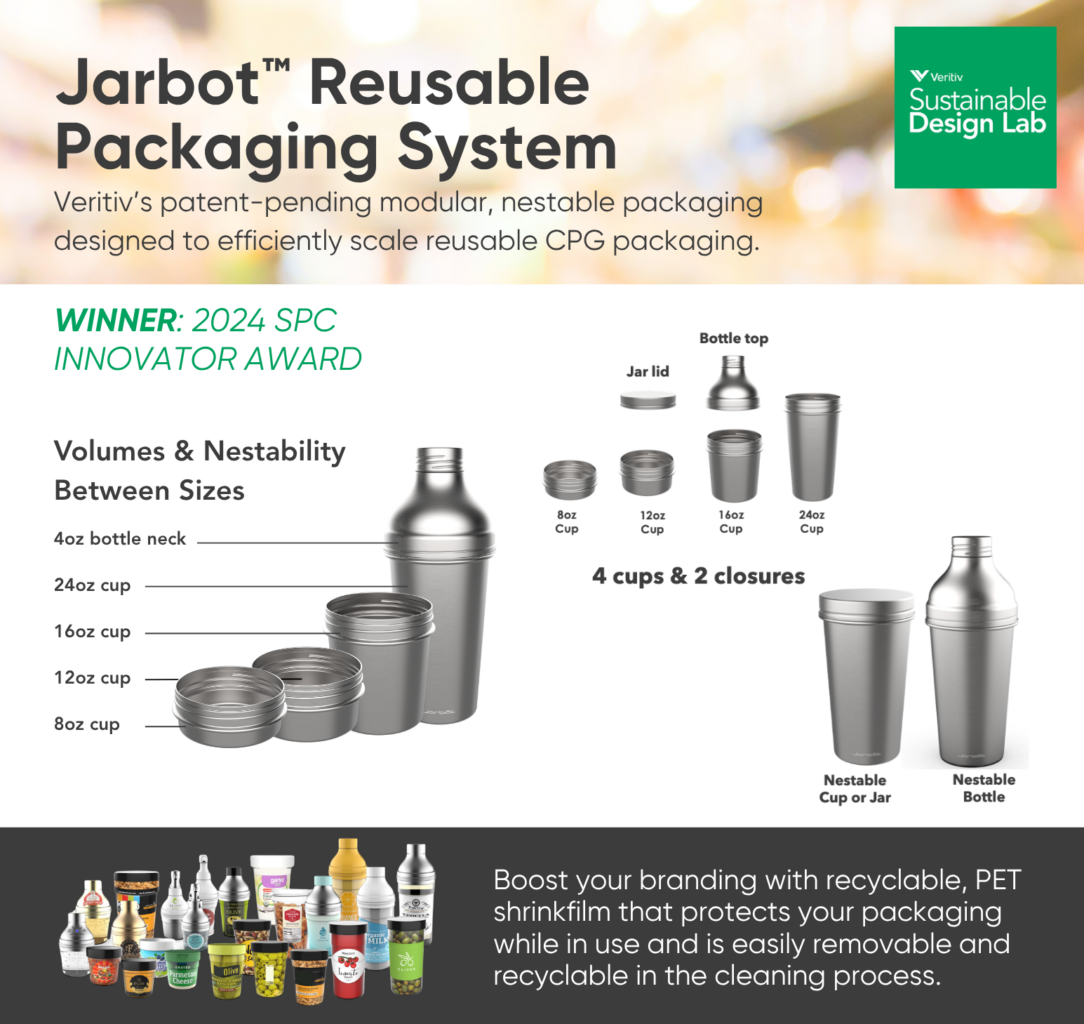
 Designed for reuse at scale: Jarbot™ is built around the “prefill” reuse model, one of the most viable pathways for CPG, enabling brands to deliver products in durable packaging that can be collected, cleaned, and redeployed efficiently
Engineered for reverse logistics: Nestable jars, cups, and closures significantly reduce return shipping costs and improve transport efficiency, addressing one of the biggest barriers to reuse systems
Shared system, not siloed packaging: Designed for cross-category pooling, Jarbot increases collection velocity by allowing multiple brands and formats to use the same packaging ecosystem, reducing storage, sorting, and cost per use
Built to overcome real-world constraints: The system directly tackles challenges like low return rates, SKU complexity, and retailer storage limitations by simplifying formats and enabling scalable collection strategies
From single-use to system thinking: Jarbot reflects a shift away from one-way packaging toward circular systems that are intentionally designed for multiple lifecycles, operational feasibility, and long-term cost efficiency
Contact Us to learn more about the Jarbot™ Reusable Packaging System and other SDL innovations!


1. Packaging Policy Momentum (SPC Policy Update)
Packaging policy activity is accelerating at both the state and federal levels, with a growing focus on extended producer responsibility (EPR), recyclability standards, and waste reduction targets. Recent updates from the Sustainable Packaging Coalition highlight how quickly the regulatory landscape is evolving.
Why it matters for packaging design:
- EPR legislation continues to expand.More U.S. states are introducing or advancing EPR laws, shifting financial and operational responsibility for packaging waste to producers.
- Recyclability definitions are tightening.Policies are increasingly aligning around what qualifies as “recyclable,” often tied to real-world collection and processing rates.
- Compliance is becoming more complex. Brands may need to navigate varying state-by-state requirements, reporting obligations, and material restrictions.
What to watch:
- Implementation timelines for existing EPR laws (e.g., California, Colorado)
- Additional states introducing packaging legislation
- Increased alignment between policy, labeling requirements, and infrastructure capabilities
2. Material Recovery Facility (MRF) Upgrades
Recycling infrastructure is quietly undergoing a major modernization cycle. Across North America, material recovery facilities are investing in automation and AI to improve sorting accuracy and recover more material from the waste stream.
Why it matters for packaging design:
- AI and robotics are improving sortation. Advanced optical sorters and robotic arms can now identify materials faster and more accurately than manual sorting.
- More materials can potentially be recovered. Upgrades help capture flexible packaging, films, and other historically difficult materials.
- Design for recycling is increasingly tied to infrastructure. Packaging that aligns with existing sorting capabilities has a higher chance of actually being recovered. Click HERE to learn more.
3. Truth in Labeling Requirements
Governments are tightening rules around recyclability claims to reduce consumer confusion and prevent misleading environmental messaging.
What’s changing:
- Recyclability claims must reflect real infrastructure. If a material cannot be widely processed in recycling systems, it may not qualify for “recyclable” labeling.
- Clear disposal instructions are becoming mandatory. Several policies require standardized on-pack recycling labeling to guide consumers.
- Scrutiny on sustainability claims is increasing. Brands are expected to substantiate environmental messaging with verifiable data. Click HERE to learn more.
Have questions about how these policy shifts impact your packaging? Connect with our sustainability specialists to assess risk, ensure compliance, and identify opportunities.



Whether you’re preparing for EPR, exploring material innovation, or looking for LCA-backed decision-making, our team can help you build a future-forward packaging strategy.
Want to collaborate on an R&D project?
Need help evaluating your packaging portfolio?
Want a tour of the Sustainable Design Lab?
We’d love to work with you. Let’s innovate together. Click Here to Get Started
Sustainably Packaged Newsletter – August 2026
You’re committed to making better, more sustainable packaging choices and we’re here to help you do that. The Veritiv Sustainable Design Lab Newsletter is your monthly link to the latest insights, trends, and expert advice directly to your inbox, so you can stay ahead in the fast-evolving world of sustainable packaging.
Whether it’s new material innovations or practical design strategies, we’ve got the knowledge you need to make informed decisions and drive your sustainability efforts forward.
Sustainably Packaged Newsletter – July 2026
You’re committed to making better, more sustainable packaging choices and we’re here to help you do that. The Veritiv Sustainable Design Lab Newsletter is your monthly link to the latest insights, trends, and expert advice directly to your inbox, so you can stay ahead in the fast-evolving world of sustainable packaging.
Whether it’s new material innovations or practical design strategies, we’ve got the knowledge you need to make informed decisions and drive your sustainability efforts forward.
Sustainably Packaged Newsletter – June 2026
You’re committed to making better, more sustainable packaging choices and we’re here to help you do that. The Veritiv Sustainable Design Lab Newsletter is your monthly link to the latest insights, trends, and expert advice directly to your inbox, so you can stay ahead in the fast-evolving world of sustainable packaging.
Whether it’s new material innovations or practical design strategies, we’ve got the knowledge you need to make informed decisions and drive your sustainability efforts forward.
Sustainably Packaged Newsletter – April 2026
You’re committed to making better, more sustainable packaging choices and we’re here to help you do that. The Veritiv Sustainable Design Lab Newsletter is your monthly link to the latest insights, trends, and expert advice directly to your inbox, so you can stay ahead in the fast-evolving world of sustainable packaging.
Whether it’s new material innovations or practical design strategies, we’ve got the knowledge you need to make informed decisions and drive your sustainability efforts forward.
Sustainably Packaged Newsletter – Feb 2026
You’re committed to making better, more sustainable packaging choices and we’re here to help you do that. The Veritiv Sustainable Design Lab Newsletter is your monthly link to the latest insights, trends, and expert advice directly to your inbox, so you can stay ahead in the fast-evolving world of sustainable packaging.
Whether it’s new material innovations or practical design strategies, we’ve got the knowledge you need to make informed decisions and drive your sustainability efforts forward.
Sustainably Packaged Newsletter – Jan 2026
You’re committed to making better, more sustainable packaging choices and we’re here to help you do that. The Veritiv Sustainable Design Lab Newsletter is your monthly link to the latest insights, trends, and expert advice directly to your inbox, so you can stay ahead in the fast-evolving world of sustainable packaging.
Whether it’s new material innovations or practical design strategies, we’ve got the knowledge you need to make informed decisions and drive your sustainability efforts forward.
Masterclass: Cold Chain
It is no secret that more and more companies are shaping strategies around sustainability – both in operations and products.
Whether your strategy includes colorful e-commerce boxes, corrugated displays, or both, sustainable practices are a must.
Masterclass: EPR
It is no secret that more and more companies are shaping strategies around sustainability – both in operations and products.
Whether your strategy includes colorful e-commerce boxes, corrugated displays, or both, sustainable practices are a must.